“The West was not slackish with its food. Line a person’s ribs well and he will do his best for the cause.”
From “Cowboy Lingo” by Ramon F. Adams, Houghton Mifflin,1936
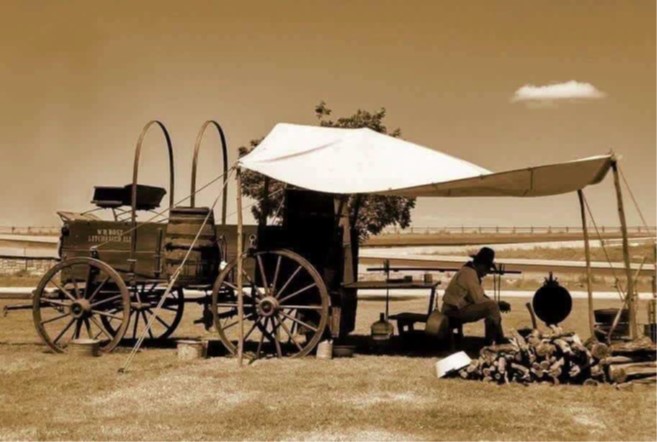
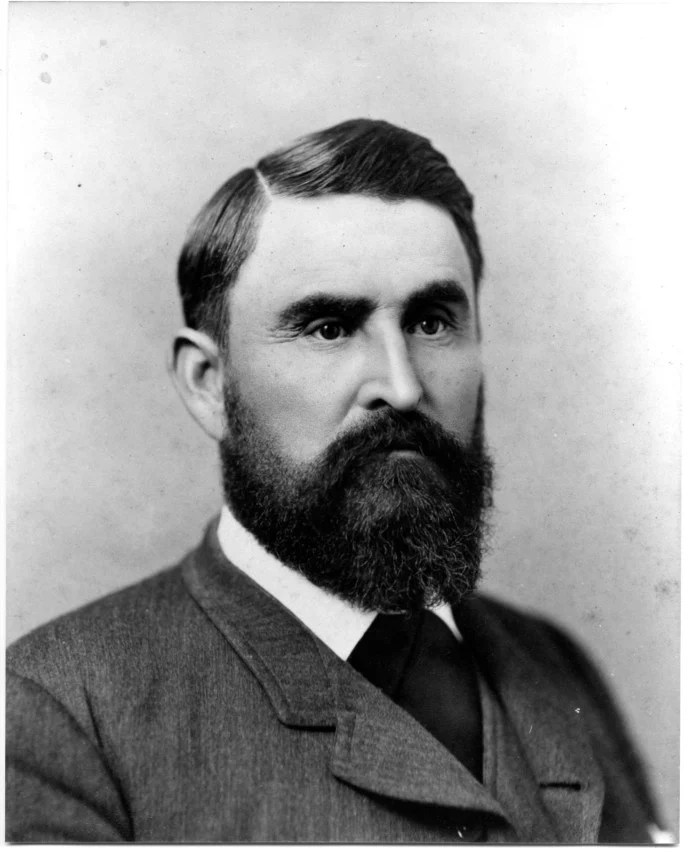
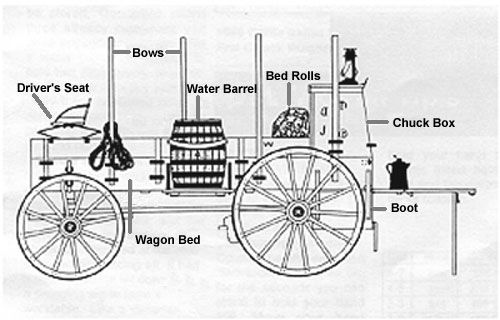
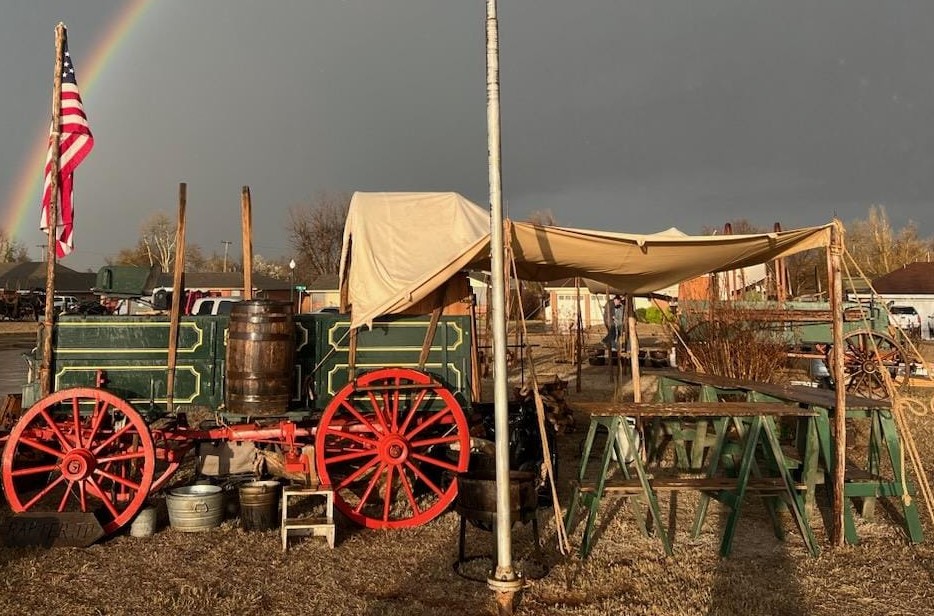
Historians credit plainsman-Texas Ranger-cattleman Charles Goodnight for transforming an army wagon into a mule-powered kitchen on wheels in 1866. By adding a wooden chuck box, or cupboard, to the back of the wagon, a cow camp cook could stow cast iron cooking utensils and enough provisions to prepare meals for a cattle driving crew. Goodnight knew that he would need to feed the drovers well so that they would be able to stay with the half-wild herd of Texas Longhorns to trails end. He hoped to successfully deliver a contract of beef to the army at Fort Sumner and drive the remainder of his herd further north to Pueblo, Colorado.
Provisions were stocked on the chuck wagon to last thirty days or more, until the next supply point. An average outfit included cattle from several ranches consisting of several thousand head of cattle. A crew of about eleven men included a trail boss, eight drovers, a horse wrangler, a cook an chuck wagon. Enough horses in the remuda were driven to provide every cowboy with four to five or more mounts.
Cookie, bean-master, cocinero, dough-belly, biscuit shooter, belly cheater, or dough-boxer.
The chuck wagon cook ruled over cow camp and also served as barber, doctor for both man and beast, banker, and stakeholder for bets. To a cowboy “the wagon” meant home where he could find hot food, strong coffee, and dry clothes.
In 1996, at a chuck wagon competition in Amarillo, Texas, a small group of Old West enthusiasts and wagon masters talked about an association. The mission would be to preserve the heritage of the chuck wagon and its use in the short, but significant, era of the cattle drives.
In 1997, in Bryson, Texas, By-laws and Articles of Operation were adopted and the American Chuck Wagon Association was off and running. Today there are members in 31 states, Canada, Germany and France. Members participate in cook off competitions, demonstrations, catering, charity events, school visits and many other activities to fulfill that original mission and even surpass the dreams of those organizers. They are dedicated to educating and serving others.
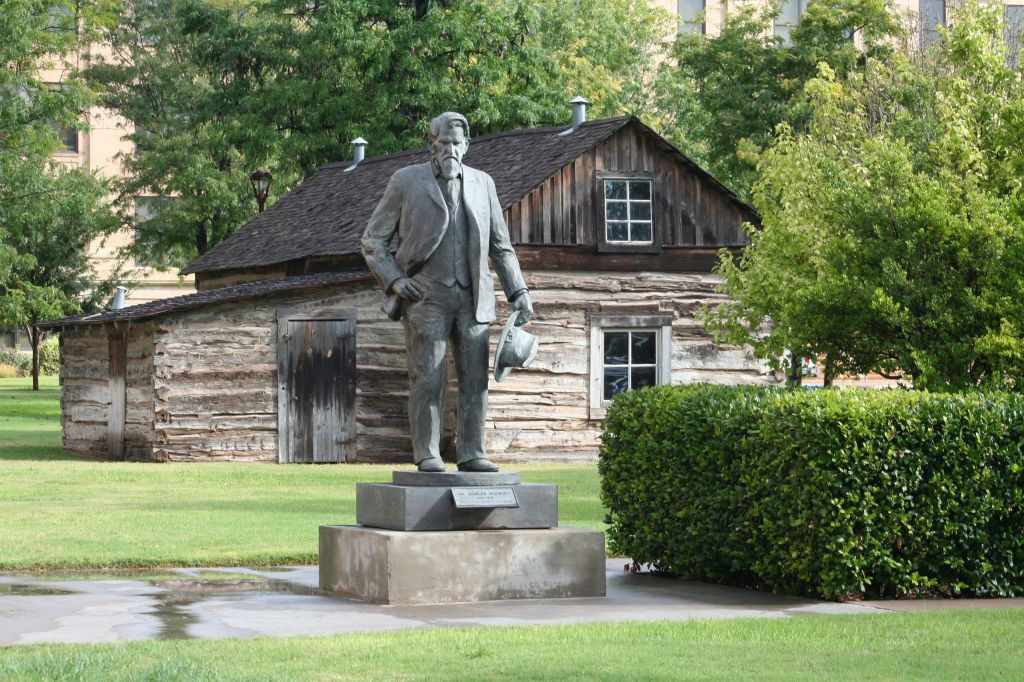
The term “chuck” is from 17th Century England used by meat merchants who referred to their lower priced goods. By the 18th Centry, “chuck” was colloquial for good, heart-warming food. So it is no suprise that Goodnight’s invention became known as a “chuck wagon”.
Most people know that the bluebonnet is the state flower of Texas, but how many know that the official vehicle is the chuck wagon! The Texas members of the American Chuck Wagon Association sought to get the chuck wagon designated the official vehicle of Texas. This seemed appropriate since it was definitely one of the first wheeled modes of transportation. Many hours over a two year period were spent talking to Legislators, especially David Holt, in an effort to convince them. Car manufacturers even got in the act wanting their brand, Ford, Dodge, Chevrolet, to be the official vehicle. The effort to get the chuck wagon designated the official vehicle was spearheaded by Jerry Baird. Finally in an effort to sway the Texas Senators several members of the ACWA descended on the capitol of Texas in the waning days of the session. A meal of rib-eye steaks, pinto beans, sourdough biscuits, potatoes and dessert was prepared by members including Jerry and Mickey Baird, Eddie Sandoval, Don and Shirley Creacy, Wayne Calk, Bob and Nancy Sparks, Gerry Self, Wilbur and Annette Wilson and Steve Wood.
Their efforts paid off. On May 26, 2005, at the 79th State Legislature, the proclamation was signed by Governor Rick Perry officially making the chuck wagon the official vehicle of Texas.
- Senate Concurrent Resolution No. 8, designating the official vehicle of the State of Texas.
For more information and chuck wagon history, links for additional reference material are listed under the Resources tab.
“The chuck wagon is a symbol of the rugged individualism and can-do spirit of the American frontier.”
BILL THOMPSON
ACWA Lifetime Member Bill Thompson writes: “The chuck wagon brings to mind the romantic image of the American West. The image of cowboys trailing cattle across the open prairies to markets in the North and East. Just how did this image evolve? At the end of the U.S. civil war in the 1860’s, a massive expansion of settlement moved westward across the North American continent. This expansion created a large market for beef. Beef that existed, on the hoof, in the southwest, primarily in Texas. Enterprising cattlemen recognized the need to move herds of cattle to market without railroads. This meant driving herds overland. The trail drive days were born. To move a herd of cattle overland meant crews of cowhands had to live in the open for months at a time. The need to feed and care for these mostly young men resulted in the development of the chuck wagon.
The chuck wagon was the cowboys’ home – for most, the only home they had. When a cowboy threw his bedroll on top of the chuck wagon, rolled inside was everything he owned except the clothes he wore and the saddle he sat on. The chuck wagon and cook had to supply everything else the cowboy needed. Meals, repairs to clothing and equipment, entertainment, medical help and moral support all came from the cowboys’ rolling home. The relationship between the cowboy and the chuck wagon was one the likes of which had never existed before. To the cowhand, the chuck wagon was much more than just a mobile kitchen. Chuck wagon cooks were notoriously cantankerous and surly. The result was much bickering and name calling between cook and cowboy. No outsider would dare to take such liberties with either. Trail crews were a family and they were loyal.
The chuck wagon is a symbol of the rugged individualism and can-do spirit of the American frontier. The spirit that enabled cattlemen to master incredible hardships while moving their herds over a vast wilderness. It is the same spirit which had led to the creation of a new nation. A nation which embraced individual rights and freedoms. A nation that led the world in two wars against tyranny and still leads that fight today. A nation that landed men on the moon and returned them safely to the earth. Not once, but six times. A nation that made capitalism a world wide way of life. This frontier spirit has shown the world the rights of individuals cannot be suppressed. That all men are indeed created equal and endowed with certain inalienable rights.
When I look at a chuck wagon, I see much more than just a mobile kitchen.
Bill Thompson, ACWA Lifetime Member
The Association has qualified for and received a 501(c)(3) status. This allows you to make tax-free Memorials, Honorariums and Donations. If you would like to make a donation, you may send a check to:
ACWA, P.O. Box 626, Belton, TX 76513.
For Memorials and Honorariums, please include the person remembered/honored, address or addresses where cards are to be sent.
“I don’t know who the Arbuckles were, but they should have a monument erected in their honor somewhere on the high plains.”
Jack Culley, Trail Driver
The Trail Drivers of Texas, J. Marvin Hunter & George W. Saunders (1924)
Thank you for visiting our site and we hope you will visit us at one or more of our chuck wagon events.
 American Chuck Wagon Association